Latest Most Asked Questions about Malaysia Location on World Map
Welcome, fellow explorers and curious minds, to the ultimate living FAQ about 'Malaysia location on world map'! We've scoured the web, listened to countless forum discussions, and gathered all the burning questions people are asking right now. This isn't just a simple rundown; it's your go-to guide, updated with the latest insights and geographical facts. Whether you're planning a trip, studying geography, or just curious about this incredible Southeast Asian nation, you'll find comprehensive answers here. We aim to clarify, inform, and even share some tips and tricks about understanding Malaysia's unique global position. Let's dive in and resolve any geographical mysteries you might have, making sure you're well-informed on this captivating topic.
General Location & Continent Explained
Where exactly is Malaysia located on the world map?
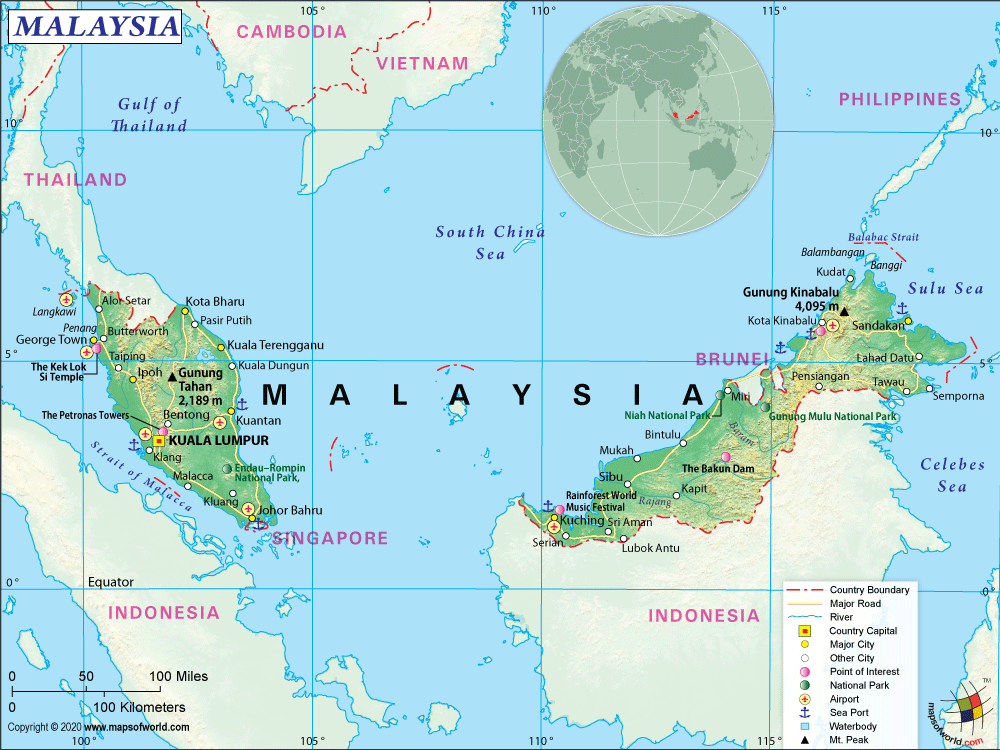
Malaysia is strategically located in Southeast Asia, positioning it just north of the equator. This unique spot grants it a consistently warm, tropical climate year-round. It's often referred to as being at a crossroads between the Indian Ocean and the Pacific Ocean, making it a significant regional player.
What continent does Malaysia belong to?
Malaysia is firmly part of the continent of Asia. Specifically, it's a prominent nation within the Southeast Asian region. Its geographical and cultural ties are deeply embedded within this diverse and dynamic part of the world, influencing its history and development.
Specific Geographical Features
Is Malaysia an island or part of a mainland?
Malaysia is actually both! It comprises Peninsular Malaysia, which is connected to mainland Asia (bordering Thailand), and East Malaysia, which is located on the northern part of Borneo Island. This dual geography makes it truly unique among nations, offering diverse landscapes.
What major bodies of water surround Malaysia?
Malaysia is bordered by several important bodies of water. To its west lies the Strait of Malacca, a crucial international shipping lane. The vast South China Sea separates Peninsular Malaysia from East Malaysia. Additionally, the Andaman Sea and Sulu Sea are also nearby, influencing its maritime activities.
Neighboring Countries & Borders
Which countries share a land border with Malaysia?
Malaysia shares land borders with several countries. Peninsular Malaysia borders Thailand to the north. In East Malaysia, it shares extensive land borders with Indonesia on Borneo Island. The tiny nation of Brunei is also entirely enveloped by Malaysia's state of Sarawak on Borneo, creating an interesting geographical dynamic.
Does Malaysia border Singapore?
Yes, Malaysia borders Singapore, but it's separated by a narrow strait called the Johor Strait. Two bridges, the Johor–Singapore Causeway and the Second Link, connect the two nations. This close proximity fosters strong economic and cultural ties, making cross-border travel very common between them.
Maritime Importance & Trade
Why is the Strait of Malacca important for Malaysia's location?
The Strait of Malacca is immensely important for Malaysia due to its strategic position as one of the world's busiest shipping lanes. It acts as a vital conduit connecting major economies of Asia, Europe, and the Middle East. This makes Malaysia a key player in global maritime trade and energy transport.
How does Malaysia's location impact global trade?
Malaysia's location significantly impacts global trade primarily through its control over a substantial portion of the Strait of Malacca. This allows the country to facilitate a massive volume of international shipping traffic. Its ports, like Port Klang, serve as crucial transshipment hubs, connecting various global supply chains.
Climate & Equator Proximity
What kind of climate does Malaysia have due to its location?
Due to its equatorial location, Malaysia experiences a tropical rainforest climate. This means it has consistently high temperatures, high humidity, and abundant rainfall throughout the year. There are no distinct seasons, but rather monsoon periods that bring heavier rains to different regions at different times.
How close is Malaysia to the equator?
Malaysia is very close to the equator, with parts of both Peninsular and East Malaysia lying just north of the line. This proximity is the primary reason for its characteristic tropical climate and lush, biodiverse rainforests. It profoundly influences its ecological systems and daily weather patterns.
Peninsular vs. East Malaysia Insights
What is the difference between Peninsular Malaysia and East Malaysia?
Peninsular Malaysia, also known as West Malaysia, is on the Malay Peninsula, bordering Thailand and Singapore, featuring major cities. East Malaysia comprises the states of Sabah and Sarawak on Borneo Island, known for rainforests and indigenous cultures. They are separated by the South China Sea, creating distinct geographical and cultural landscapes.
Why is Malaysia divided into two separate landmasses?
Malaysia's division into two landmasses is primarily due to historical and geographical factors. Peninsular Malaysia was historically the center of Malay sultanates and British colonial administration. East Malaysia (Sabah and Sarawak) joined the federation later, bringing in large territories on Borneo, naturally separated by the South China Sea.
Historical Context of Location
How did Malaysia's location influence its history?
Malaysia's strategic location along ancient trade routes profoundly influenced its history. It attracted diverse traders and empires from India, China, and the Middle East, leading to the early establishment of port cities. This also made it a coveted prize for colonial powers, shaping its multicultural society and eventual independence.
Was Malaysia always located where it is now?
Yes, the landmasses that constitute modern Malaysia have always been in their current geographical position. However, the political entity known as Malaysia was formed in 1963, uniting various states and territories. The physical geography remains constant, but the national boundaries evolved over time.
Economic & Strategic Significance
What is the economic importance of Malaysia's location?
Malaysia's location is economically vital due to its central role in global trade, particularly through the Strait of Malacca. This facilitates easy access to international markets, making it attractive for foreign investment and manufacturing. It also has rich natural resources, contributing significantly to its economic stability and growth.
Is Malaysia considered a strategically important country?
Absolutely, Malaysia is considered highly strategically important. Its position controlling parts of the Strait of Malacca gives it immense geopolitical leverage. This location is crucial for global shipping and energy security. Its influence extends across Southeast Asia, impacting regional stability and economic development.
Common Misconceptions Addressed
Is Malaysia part of China or India?
No, Malaysia is not part of China or India. It is an independent sovereign nation located in Southeast Asia. While it has historical and cultural ties with both, particularly through trade and migration, it maintains its unique national identity and political autonomy, distinct from any other country.
Is Malaysia located near the Philippines or Australia?
Malaysia is located relatively near the Philippines, particularly East Malaysia (Sabah) which is southwest of the Philippines. However, it is quite far from Australia, which lies much further to the south. While both are in the broader Asia-Pacific region, their direct proximity is limited.
Future Global Role & Location
How might Malaysia's location impact its future global role?
Malaysia's strategic location will likely continue to enhance its future global role, especially in trade and regional diplomacy. As global trade routes evolve and maritime security becomes even more critical, Malaysia's position on key waterways will ensure its continued relevance. It will likely remain a significant bridge between various global economies.
What role does Malaysia's location play in regional stability?
Malaysia's central location in Southeast Asia plays a crucial role in regional stability. It acts as a bridge between mainland and island Southeast Asia, and its diplomatic efforts often help mediate regional disputes. Its commitment to ASEAN further solidifies its role in fostering peace and economic cooperation within the diverse region.
Still have questions? Feel free to ask more in the comments below! Perhaps you are wondering about the best time to visit Malaysia considering its tropical location?
Malaysia world map location, where is Malaysia, Malaysia geography, Southeast Asia location, Strait of Malacca, Peninsular Malaysia, East Malaysia, Malaysia global positionUnderstanding Malaysia's precise location on the world map is crucial for appreciating its geopolitical significance. This comprehensive guide delves into the fascinating geography of this Southeast Asian nation, highlighting its unique split landmass. We explore its position relative to vital maritime trade routes, neighboring countries, and significant bodies of water. Discover how Malaysia's equatorial proximity shapes its climate and biodiversity, making it a truly captivating destination. This article addresses frequent queries and offers detailed insights, helping to resolve any geographical ambiguities regarding Malaysia's place in the global landscape, providing essential navigational and informational context for every curious mind.
So, you are wondering, 'Where exactly is Malaysia on the world map?' Honestly, it is a fantastic question people ask all the time, and I have got the lowdown for you. Many people often confuse it or simply are not sure of its incredible, strategic spot. But trust me, once you understand its location, you will see why it is such a vital and fascinating country for everyone.
Malaysia holds a truly unique geographical position in Southeast Asia. This nation is globally recognized for its vibrant culture and stunning natural beauty. But really, its placement on the world map is what makes it so significant. We are going to explore this together right now.
Unpacking Malaysia's Global Address
Malaysia is located in Southeast Asia, truly a vibrant and bustling region. It is situated just north of the equator, which gives it a consistently warm and tropical climate all year long. This specific location is incredibly important for global trade routes. It really shapes its distinct natural environment.
The country is famously divided into two distinct geographical parts, which honestly makes it quite unique. There is Peninsular Malaysia, often called West Malaysia, and then there is East Malaysia, which is located on the island of Borneo. This separation is key.
Peninsular Malaysia: The Mainland Heart
Peninsular Malaysia is the western part of the country, actually forming the southern tip of the Malay Peninsula. It shares a land border with Thailand to its north, which is a major connection point. To the south, across a narrow strait, you will find Singapore, a very important regional hub. This area is known for its bustling cities and historical sites.
This peninsula is flanked by significant bodies of water, which are essential for its economy. The Strait of Malacca lies to its west, a really busy shipping lane. To the east, the South China Sea separates it from East Malaysia and other nations. It truly is a crossroads for trade.
East Malaysia: Borneo's Hidden Gem
East Malaysia occupies a substantial portion of the northern part of Borneo Island. This area is geographically distinct and truly diverse. It comprises the states of Sabah and Sarawak, both renowned for their incredible rainforests and indigenous cultures. Brunei, another sovereign nation, is actually embedded within Sarawak. Indonesia also shares a long land border with East Malaysia. This part of Malaysia is absolutely vital for its natural resources. It contributes greatly to the nation's rich biodiversity and unique ecosystems. Honestly, it is a world away from the peninsula.
Neighboring Nations and Maritime Routes
Knowing Malaysia's neighbors truly helps you picture its location more clearly. As we discussed, Thailand is to the north of Peninsular Malaysia. Singapore is just across the Johor Strait to the south. In East Malaysia, Indonesia’s Kalimantan region shares a long border, and Brunei is a small enclave. These shared borders foster rich cultural exchanges. They also sometimes present interesting geopolitical dynamics. It is quite a busy neighborhood.
Malaysia's location is strategically vital due to its proximity to major maritime trade routes. The Strait of Malacca, in particular, is one of the world's busiest shipping lanes, you know. It connects the Indian Ocean to the Pacific Ocean, making Malaysia a key player. Billions of dollars in trade pass through this narrow waterway annually. This includes a huge portion of the world's oil shipments. It truly makes Malaysia a global trade linchpin. This maritime importance cannot be overstated at all.
The Equatorial Influence: Climate and Biodiversity
Situated very close to the equator, Malaysia experiences a consistently hot and humid tropical climate. This means sunshine throughout the year, with ample rainfall, which is great for its lush landscapes. There are no distinct four seasons like in temperate regions. Instead, it really has two monsoon seasons. These seasons influence rainfall patterns across the peninsula and Borneo. This consistent tropical weather sustains an incredibly rich biodiversity, especially its famous rainforests. Honestly, it is a paradise for nature lovers, you know. The diverse flora and fauna are simply stunning. It truly feels like another world sometimes.
Connecting the Dots: Why Malaysia's Location Matters
So, why is all this geographical talk so important, you might ask? Well, Malaysia's unique location has shaped its history, culture, and economic development significantly. Its position as a maritime crossroads historically attracted traders and settlers from India, China, and the Middle East. This rich history has created a wonderfully multicultural society. You can see it in their food, festivals, and languages. The country's strategic position continues to make it an attractive hub for foreign investment. It really underpins its role in global supply chains. Honestly, understanding its spot on the map truly helps you appreciate this amazing country more. I think it is fascinating how geography plays such a huge role. Does that make sense now?
Malaysia's strategic Southeast Asian location, divided into Peninsular Malaysia and East Malaysia. Borders Thailand, Singapore, Brunei, and Indonesia. Crucial for shipping via Strait of Malacca. Positioned near the equator, influencing its tropical climate. Surrounded by South China Sea, Andaman Sea, and Sulu Sea.


Malaysia Location On The World Map Malaysia Location Map . Malaysia Location On The World Map Malaysia World . Where Is Malaysia Where Is Malaysia . Where Is Malaysia Mappr Malaysia Location Map . Malaysia Location In World Map Malaysia On World Map


Where Is Malaysia Located On The World Map Malaysia Location . Where Is Malaysia Located Location Map Of Malaysia Malaysia Location Map . This Stock Image Shows The Location Of Malaysia On A World Map Stock This Stock Image Shows The Location Of Malaysia On A World Map 2RX7MFH . World Map Malaysia Malaysia World Map 550x550 . Malaysia Location In World Map Malaysia Map


Malaysia Map Maps Malaysia South Eastern Asia Asia Malaysia On World Map . Malaysia On World Map Map Malaysia Map Overall . Malaysia Maps Facts World Atlas My 02 . Malaysia Location On The Asia Map Malaysia Location On The Asia Map . Map Of Malaysia Where Is Malaysia Located Map Of Malaysia


Political Map Of Malaysia Nations Online Project Malaysia Map . Malaysia On The World Stage A Overview Pacific Centered World Map With Magnified Malaysia Flag And Map Of Malaysia On Asia In Center World Map 2F9R4F5 . Malaysia History Flag Map Population Language Religion Facts Malaysia Map Boundaries Cities Locator . Malaysia Map Located On A World Map With Flag And Map Pointer Or Pin Malaysia Map Located World Flag Pointer Pin Infographic Vector Isolated White 140960743 . Malaysia Maps Facts World Atlas My 01




Map Of Malaysia Facts Information Beautiful World Travel Guide Malaysia Map . Malaysia Malaysia Overview AKANLAKU Malaysia Map Cities 0 . Malaysia Map Map Of Malaysia Malaysia Map . Malaysia Maps Facts World Atlas States And Territories Of Malaysia Map . Malaysia In World Map


Locations Malaysia Standard Chartered Bank Locations In Malaysia IRYRK Red Push Pin Pointing On Location Of Malaysia World Map Close Up View Stock Photograph 2M1M351 . Singapore Malaysia Maps Location Tourist Spots Routes 2026 Malaysia And Singapore In World Map . Malaysia 2026 Public Holiday Free Printable Templates Hub Malaysia Map . Thailand Singapore Map Location Attractions Itinerary 2026 Singapore Malaysia Thailand In World Map . Los 10 Mejores Lugares Para Visitar En Malasia Con Fotos Y Mapa Malaysia Map 0


Malaysia Location Modern Detailed Vector Map Malaysia Location Modern Detailed Vector 260nw 441711073 . Malaysia Maps Map Political 1 . Free Malaysia On World Map For PowerPoint And Google Slides PPT Slides Malaysia On World Map Slide1 . Premium Vector Location Of Malaysia On The World Map Marked With Location Malaysia World Map Marked With Malaysia Flag Pin 292608 37065 . Malaysia Maps Malaysia Map 2